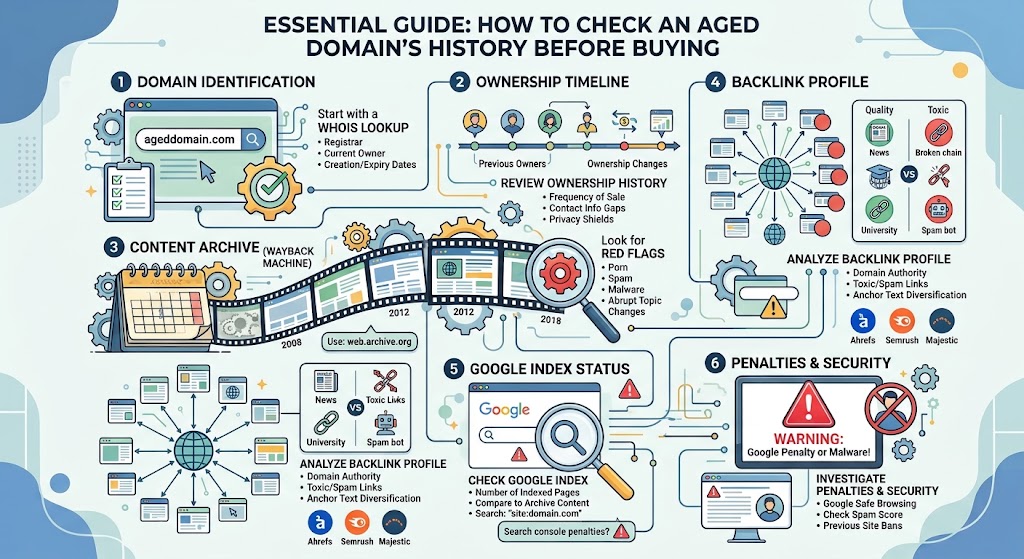
Buying an aged domain can be an interesting strategy for SEO, content websites, affiliate projects, local businesses, and link-building campaigns. However, a domain being several years old does not automatically make it valuable.
An aged domain may have a strong history, relevant backlinks, established pages, and a clean reputation. On the other hand, it may have been used for spam, private blog networks, malware, expired-content sites, or completely unrelated businesses.
This is why checking the history of an aged domain before buying it is essential.
In this guide, we will explain how to investigate an aged domain step by step, what signals to look for, which warning signs should make you reconsider the purchase, and how to determine whether a domain’s history could actually be useful for SEO.
Why Domain History Matters
The current metrics of a domain only tell part of the story.
A domain may have a high Domain Rating (DR), Domain Authority (DA), or a large number of backlinks, but those metrics can hide important problems.
For example, imagine finding a domain with:
- 10 years of registration history
- 500 referring domains
- High third-party authority metrics
- Thousands of backlinks
At first glance, it may appear to be an excellent SEO domain.
But further investigation could reveal that the domain previously hosted:
- Casino content
- Adult content
- Pharmaceutical spam
- Automatically generated articles
- A private blog network
- Malware
- Unrelated foreign-language websites
- Redirects to suspicious websites
The historical use of the domain can therefore be just as important as its current SEO metrics.
1. Check When the Domain Was First Registered
The first step is to determine how old the domain actually is.
A domain’s current registration date does not necessarily tell you the entire story. A domain may have been registered many years ago, dropped, and then registered again by a completely different owner.
This distinction is extremely important.
For example:
Domain A
Registered in 2012 and continuously maintained until today.
Domain B
Originally registered in 2012, dropped in 2018, and registered again in 2025.
Both domains may appear to have a 13-year history in some tools, but their ownership and operational histories are very different.
When evaluating an aged domain, try to determine:
- Original registration date
- Expiration dates
- Periods when the domain was inactive
- Registration changes
- Whether the domain has been dropped
- How many times it has changed hands
The goal is not simply to find the oldest domain. You want to understand its actual history.
2. Use the Wayback Machine to See Old Websites
One of the most useful tools for researching domain history is the Internet Archive’s Wayback Machine.
It allows you to see historical versions of websites associated with a domain.
Enter the domain and examine snapshots from different years.
For example, suppose you are considering:
exampledomain.com
You might discover that:
- From 2015–2018 it was a technology blog
- From 2019–2021 it hosted a business website
- In 2022 the domain expired
- In 2023 it became a gambling website
- In 2024 it was used for spam
That history should influence your buying decision.
Look for consistency in the site’s topic and quality.
A domain that has historically covered the same or a closely related subject can be more attractive than a domain that has repeatedly changed topics.
3. Check What the Domain Was Used For
Historical snapshots can reveal much more than just the site’s design.
Pay attention to the actual purpose of the website.
Ask yourself:
What kind of website existed on this domain?
Potentially positive historical uses include:
- Business websites
- Industry publications
- Blogs
- Educational resources
- Local businesses
- Professional organizations
- News websites
- Specialized niche websites
Potential warning signs include:
- Spam directories
- Auto-generated content
- Casino sites
- Adult websites
- Pharmaceutical spam
- Malware pages
- Doorway pages
- Aggressive affiliate sites
- Foreign-language spam
- Link networks
A domain’s previous topic can help you determine whether its existing backlinks and historical authority make sense for your intended project.
4. Examine the Domain’s Backlink History
Backlinks are one of the biggest reasons people purchase aged domains.
However, you should never judge a domain based solely on the number of backlinks it has today.
Instead, analyze the historical backlink profile.
Important questions include:
- How many referring domains does it have?
- Are those referring domains legitimate?
- Are the links still active?
- What pages received the links?
- What anchor text was used?
- Are the links editorial?
- Are they relevant to the domain’s topic?
- Did the domain suddenly acquire thousands of links?
A domain with 50 highly relevant editorial backlinks can potentially be more interesting than one with 10,000 low-quality links.
5. Investigate Anchor Text
Anchor text can provide valuable clues about how a domain was previously promoted.
Suppose you discover an aged domain with backlinks using anchor text such as:
- Best accounting software
- Accounting resources
- Small business accounting
- Financial management guide
That could make sense if the domain historically belonged to an accounting website.
Now imagine another domain with hundreds of anchors such as:
- Buy cheap casino
- Online betting
- Best payday loans
- Adult keywords
That history deserves much more scrutiny.
Look for a natural distribution of:
- Branded anchors
- URL anchors
- Generic anchors
- Topical keywords
An unnatural concentration of commercial keywords can indicate aggressive SEO manipulation.
6. Check the Referring Domains
Don’t stop at the backlink count.
Look at the websites actually linking to the domain.
A strong backlink profile may contain links from:
- Industry publications
- Universities
- Government websites
- Established companies
- News sites
- Relevant blogs
- Professional organizations
However, be careful with metrics alone.
A referring domain with a high authority score is not necessarily a valuable website.
Open representative referring websites and inspect them manually.
Ask:
Would I consider this a legitimate website even if it didn’t provide an SEO metric?
That simple question can eliminate many questionable domains.
7. Look for Sudden Drops in Backlinks
Historical backlink graphs can reveal important events.
For example, a domain might have:
- 20 referring domains in 2016
- 45 in 2018
- 100 in 2020
- 3,000 in 2021
- 40 in 2023
A sudden increase followed by a massive collapse deserves investigation.
It could indicate:
- A link-building campaign
- A sitewide link network
- Expired domains being manipulated
- A previous SEO experiment
- A spam campaign
A natural website generally tends to acquire links progressively as its content becomes known.
Not every spike is bad, but unexplained spikes deserve further research.
8. Check Historical Traffic
If reliable historical traffic data is available, examine it.
Traffic trends can help identify whether the domain previously had a genuine audience.
For example, a domain that received consistent organic traffic for several years may have had real visibility and useful content.
Conversely, a domain that shows almost no meaningful traffic despite having thousands of backlinks may have been primarily built for SEO manipulation.
Traffic data should not be treated as absolute proof, because historical estimates from third-party tools are imperfect.
Still, traffic trends can provide valuable context.
9. Check for Previous Redirects
Redirect history is another important part of domain research.
A domain may have been redirected to another website at some point.
For example:
OldDomain.com → AnotherWebsite.com
If this happened repeatedly, you should investigate why.
Multiple redirects can indicate:
- Domain acquisitions
- Business mergers
- Rebranding
- SEO experiments
- Manipulative link strategies
You should also determine whether the domain previously received redirects from other domains.
A domain that accumulated authority through a large number of unrelated redirects may deserve more caution than a domain that built its reputation naturally.
10. Search the Domain on Google and Other Search Engines
Perform a basic search for the domain name.
Try variations such as:
“exampledomain.com”
and:
exampledomain
Look for mentions, old articles, reviews, complaints, forum discussions, business references, and other historical information.
You can also search for specific phrases related to the domain.
This can help you discover information that conventional SEO tools may not show.
For example, you might find that the domain previously belonged to:
- A legitimate company
- A popular publication
- A controversial website
- A hacked website
- A discontinued project
Historical mentions can help reconstruct the domain’s story.
11. Check for Spam or Malware History
A domain’s past reputation is important.
Search for signs that the domain was previously compromised or used for malicious activity.
Warning signs include:
- Malware warnings
- Large numbers of spam pages
- Hacked pharmaceutical pages
- Automatically generated URLs
- Thousands of unrelated indexed pages
- Suspicious foreign-language content
- Fake product pages
- Phishing-related content
If you find evidence of serious abuse, think carefully before buying the domain.
A low purchase price may not compensate for the problems associated with a heavily abused domain.
12. Analyze Topical Relevance
One of the most important questions is:
Does the domain’s history make sense for the project I want to build?
Suppose you want to create a website about digital marketing.
An aged domain that previously covered:
- SEO
- Online marketing
- Web development
- Advertising
could have a logical relationship with your project.
But an aged domain that previously belonged to an unrelated furniture store, gambling site, or pharmaceutical website may offer fewer obvious advantages.
Topical relevance is particularly important when evaluating historical backlinks.
A relevant link from a website in the same industry can make much more sense than a random link from an unrelated niche.
13. Check Whether Important Pages Still Exist
Sometimes an aged domain has valuable backlinks pointing to specific historical pages.
For example:
exampledomain.com/seo-guide/
may have received links from several authoritative websites.
If you purchase the domain and the old URL disappears, some of that value may be lost.
Therefore, identify important historical URLs and investigate whether they can be recreated appropriately.
If you rebuild an old resource, make sure the new page genuinely serves a similar purpose rather than creating a misleading page simply to capture historical links.
14. Look for Signs of a Domain Drop
A dropped domain is not automatically bad.
Many perfectly legitimate domains expire because:
- A business closes
- A project is abandoned
- An owner forgets to renew it
- A company changes its brand
- A website moves to another domain
The important thing is what happened before and after the drop.
If a domain was a legitimate business website for ten years and then expired, its history may still be interesting.
But if it was repeatedly registered, dropped, and repurposed for different SEO projects, caution is appropriate.
15. Build a Simple Domain History Checklist
Before buying an aged domain, review these factors:
| Factor | What to Look For |
|---|---|
| Domain age | Genuine historical registration |
| Ownership history | Reasonable changes and continuity |
| Wayback history | Legitimate websites and consistent topics |
| Backlinks | Quality and relevance |
| Referring domains | Real websites rather than spam |
| Anchor text | Natural distribution |
| Traffic | Evidence of genuine visibility |
| Redirects | Limited and logical redirects |
| Historical content | Useful, legitimate resources |
| Spam | No major history of abuse |
| Malware | No significant security problems |
| Relevance | Connection to your intended project |
This checklist can prevent many expensive mistakes.
Aged Domain History: Quality Over Age
One of the biggest mistakes beginners make is assuming that an older domain is automatically better.
It isn’t.
A 15-year-old domain with a poor history may be significantly less attractive than a five-year-old domain with:
- A clean history
- Relevant backlinks
- Consistent content
- Legitimate referring domains
- Natural anchor text
- Genuine historical traffic
The goal should therefore be to find quality history, not simply maximum age.
Common Mistakes When Checking Aged Domains
Looking Only at DR or DA
Third-party metrics are useful for comparison, but they are not Google’s ranking scores.
Never buy a domain solely because it has a high DR or DA.
Looking Only at Backlink Quantity
Thousands of backlinks don’t necessarily represent thousands of valuable links.
Always inspect the quality and source of those links.
Checking Only the Current Website
The current website may not tell you anything about what happened five or ten years ago.
Historical snapshots are essential.
Ignoring Topical Changes
A domain that changed niches repeatedly may have a complicated history.
Understand those changes before purchasing.
Assuming Every Lost Link Will Return
Historical backlinks may disappear after a domain changes hands.
Don’t assume that every old link will automatically retain its value.
Final Thoughts
Checking the history of an aged domain before buying it is one of the most important steps in domain investing and SEO.
The domain’s age is only the beginning.
You should investigate its previous websites, ownership periods, backlinks, referring domains, anchor text, traffic, redirects, historical content, and potential spam or malware activity.
The best aged domains are usually not the ones with the biggest numbers. They are the ones with a credible, relevant, and relatively clean history.
Before purchasing, take the time to reconstruct the domain’s past. A few hours of research can help you avoid buying a domain with hidden problems and increase the chances of selecting an aged domain that fits your SEO strategy.
Remember: an aged domain is an asset only when its history supports its value. Research first, buy second.