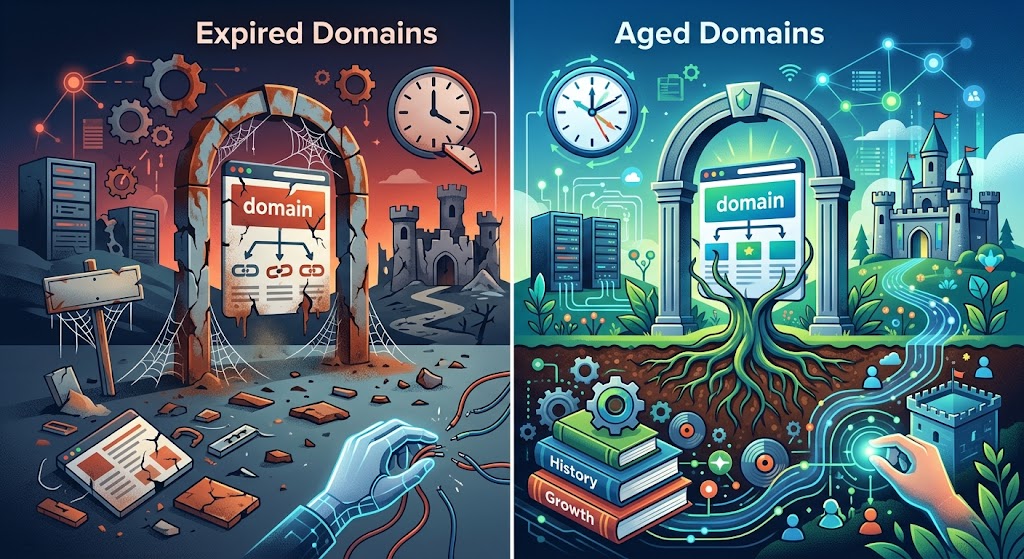
When researching domains for SEO, you will often come across two terms: expired domains and aged domains. Although these terms are sometimes used interchangeably, they describe different situations.
Understanding the difference is important if you are looking to buy domains for SEO, content websites, affiliate projects, brand development, or link building.
An aged domain generally refers to a domain that has been registered for a significant period of time and has an established history. An expired domain, on the other hand, is a domain whose previous registration has ended and which may become available for someone else to register.
But there is more to the distinction than simply age.
In this guide, we will explain what expired and aged domains are, how they differ, their potential SEO advantages, their risks, and what you should consider before buying either type.
What Is an Aged Domain?
An aged domain is a domain that has existed for a certain period of time and has accumulated some degree of history.
For example, a domain registered in 2015 and continuously maintained by its owner until today could be considered an aged domain.
However, domain age alone does not make a domain valuable.
An aged domain may have:
- A long registration history
- Existing backlinks
- Historical content
- Referring domains
- Brand mentions
- Organic traffic
- Established topical relevance
- Previous business or publishing activity
The quality of these elements is generally more important than the number of years since the domain was first registered.
Example of an Aged Domain
Imagine a domain that has been used as a technology publication since 2014.
Over the years, it has published hundreds of articles and received links from technology blogs, news websites, and industry publications.
If the domain is still active and owned by the same organization, it represents a classic example of an aged domain with an established history.
What Is an Expired Domain?
An expired domain is a domain whose registration was not renewed by its previous owner.
After the registration expires, the domain can eventually go through a series of stages before becoming available for registration or auction.
The exact process depends on the domain extension and registrar.
An expired domain may have previously been:
- A business website
- A blog
- An online publication
- An ecommerce store
- A local business
- An abandoned project
- An SEO website
- A spam website
This means that not every expired domain is valuable.
Some expired domains have excellent historical backlinks and strong brand recognition, while others have little or no SEO value.
Expired Domains vs. Aged Domains
The easiest way to understand the difference is to think about status versus history.
An aged domain describes the domain’s history and age.
An expired domain describes the fact that the previous registration has ended.
A domain can actually be both.
For example:
Domain registered in 2012 → used for 10 years → registration expires in 2022 → becomes available in 2023
That domain has an aged history, but it is also an expired domain.
This distinction is important because an expired domain may retain historical signals from its previous life, but you need to investigate what happened during the transition.
Key Differences Between Expired and Aged Domains
| Factor | Aged Domain | Expired Domain |
|---|---|---|
| Registration status | Usually active | Previous registration ended |
| Historical age | Often significant | May be significant |
| Previous owner | May still own it | Usually no longer owns it |
| Website history | Often available | Needs investigation |
| Backlinks | May still be active | Some may remain |
| SEO potential | Depends on history | Depends heavily on history |
| Risk level | Often lower if continuously maintained | Can be higher |
| Availability | Usually purchased from owner or marketplace | Often auctioned or registered |
| Main advantage | Established continuity | Opportunity to acquire an existing history |
Does an Expired Domain Lose Its SEO Value?
This is one of the most common questions about expired domains.
The answer is not simply yes or no.
When a domain expires, its historical signals do not necessarily disappear instantly. However, search engines evaluate websites and links based on many factors, and there is no guarantee that historical authority will transfer simply because someone registers the domain.
Several things can affect the situation:
- The domain’s previous use
- Whether backlinks remain live
- Whether those links are relevant
- Whether the domain changes topic
- How the new website is developed
- Whether the old content is preserved or replaced
- The quality of the historical backlink profile
Therefore, buying an expired domain should never be treated as a guaranteed SEO shortcut.
Why People Buy Expired Domains
Expired domains can be attractive because they may provide an opportunity to acquire a domain with an existing history.
Potential advantages include:
Existing Backlinks
A domain may have links from websites that were built over many years.
If those links are legitimate, relevant, and still active, they can make the domain more interesting.
Historical Content
Some expired domains have hundreds of old URLs that demonstrate the site’s previous topical focus.
This information can help buyers understand what the domain was previously about.
Existing Brand Recognition
Some domains have been associated with real businesses or organizations.
Even after a project closes, the domain may still have mentions across the internet.
Lower Acquisition Cost
Depending on the domain, an expired domain can sometimes be acquired for less than purchasing an established premium domain directly from an owner.
However, competitive domains can also become expensive at auction.
Why People Buy Aged Domains
Aged domains are often attractive because they can provide continuity.
For example, a buyer may acquire an established domain that already has:
- A recognizable name
- Historical content
- Existing backlinks
- A topical history
- Brand references
- Organic search visibility
An aged domain can therefore be useful when building a new website that is closely related to its historical purpose.
Which Is Better for SEO?
There is no universal winner.
A high-quality aged domain can be better than a poor expired domain.
But a high-quality expired domain can also be more valuable than an ordinary aged domain.
The most important factor is the domain’s overall history.
Consider these two examples.
Domain A: Aged Domain
- 12 years old
- No meaningful backlinks
- Several unrelated niche changes
- Very little historical traffic
- Multiple periods of inactivity
Domain B: Expired Domain
- 7 years old
- Previously used by a legitimate business
- Relevant editorial backlinks
- Strong topical consistency
- Natural anchor text
- Good historical content
Domain B could be more attractive for an SEO project despite being younger.
This illustrates why quality matters more than age alone.
What to Check Before Buying an Expired Domain
If you are considering an expired domain, investigate its history carefully.
1. Check the Wayback Machine
Look at historical versions of the website.
Determine:
- What the website was about
- How long it operated
- Whether the topic changed
- Whether spam appeared
- Whether the domain was redirected
2. Analyze Backlinks
Use an SEO tool to examine:
- Referring domains
- Backlink quality
- Anchor text
- Link relevance
- Lost backlinks
- Follow/nofollow distribution
- Historical backlink growth
3. Check Historical Traffic
Look for evidence that the domain previously attracted genuine visitors.
A large backlink count combined with almost no historical visibility deserves additional investigation.
4. Check Spam Signals
Look for evidence of:
- Casino spam
- Adult content
- Pharmaceutical spam
- Automatically generated pages
- Malware
- Private blog networks
- Unrelated foreign-language pages
5. Check the Domain’s Topical Relevance
Ask whether the previous niche is related to your planned project.
A relevant history can make the transition much more logical.
What to Check Before Buying an Aged Domain
The process is similar, but you should also investigate whether the domain has been continuously maintained.
Check:
- Registration history
- Ownership changes
- Website history
- Content consistency
- Backlinks
- Referring domains
- Organic traffic
- Historical redirects
- Brand mentions
- Spam signals
If the domain has been continuously used by a legitimate business or publication, that continuity can be a useful positive signal.
Expired Domain Auctions
Many valuable expired domains do not simply become available for standard registration.
They may enter an auction process.
This creates a competitive environment where multiple buyers can bid for the same domain.
Before bidding, establish a maximum budget.
It is easy to become emotionally attached to a domain because it has a strong metric profile or an attractive name.
But a high DR or DA number does not automatically justify a high purchase price.
Calculate the potential value based on the complete domain history.
Risks of Expired Domains
Expired domains can carry additional risks.
Lost Backlinks
Some websites may remove links after discovering that the original domain changed ownership.
Topic Changes
If the new website is completely unrelated to the old one, historical relevance may be less useful.
Spam History
A domain previously used for manipulation may have a problematic backlink profile.
Inflated Metrics
Some domains have artificially inflated SEO metrics created through low-quality link networks.
Previous Penalties or Problems
A domain’s history may contain issues that are not obvious from its basic metrics.
This is why due diligence is essential.
Risks of Aged Domains
Aged domains are not risk-free either.
An old domain can have:
- Toxic backlinks
- Previous spam
- Multiple owners
- Unrelated historical topics
- Poor-quality content
- Traffic losses
- Artificial link-building campaigns
Never assume that an active domain is automatically safe.
The same research principles should be applied.
Expired Domains and Link Building
One reason expired domains attract attention is their potential use in link-building strategies.
However, simply purchasing a domain and placing links on it does not guarantee SEO benefits.
If you intend to use an acquired domain as part of a broader content or link-building strategy, focus on creating a legitimate website with useful content.
A strong approach is to build the domain around a topic that fits its historical identity.
For example, if an expired domain previously covered digital marketing, rebuilding it as a useful marketing resource is more logical than turning it into an unrelated site purely to publish links.
Should You Choose an Expired or Aged Domain?
The answer depends on your objectives.
Choose an aged domain when you prioritize:
- Continuity
- Established branding
- Existing website history
- A stable project
- An existing business or publication
Consider an expired domain when you are looking for:
- A domain with historical backlinks
- An established name
- A niche-relevant domain
- A potentially undervalued acquisition
- A domain available through an auction or expired-domain marketplace
In both cases, the same principle applies:
Research the history before buying.
Final Verdict
The difference between expired domains and aged domains is primarily about their registration status and history.
An aged domain generally refers to a domain with a significant history, while an expired domain refers to a domain whose previous registration has ended.
An expired domain can also be an aged domain if it has accumulated years of legitimate history before expiration.
Neither category is automatically better for SEO.
What matters most is the quality of the domain’s history, including its backlinks, referring domains, topical relevance, historical content, traffic, ownership patterns, and spam profile.
Instead of asking:
“How old is this domain?”
ask:
“What happened on this domain over the years?”
That question can reveal far more about its potential value.
For SEO investors and website builders, the best domain is rarely the one with the biggest number attached to it. It is the domain with a credible history, relevant authority, natural backlinks, and a clear future use case.
Research carefully, set a realistic budget, and evaluate the entire history before making your purchase.